Interview • 01.12.2026

Turning data into intelligence

A peek into the AI foundry

Everyone is talking about AI, but where and how does data actually become transformed into this new intelligence? At DAKOSY, the relatively new Data Science department is working to prepare data for AI applications, identify patterns, and intelligently link information. What often appears to users as magic is actually the result of meticulous work by data scientists and data engineers. In a conversation with Rachel Schröder and Csaba Barath, their work comes into focus.

Profile Rachel Schröder

I first came into contact with AI when 
I was studying chemistry and trained a neural network to predict the physical properties of a certain class of substances. 

What makes me particularly qualified for this position on the Data Science team is 
my enthusiasm for the subject, my professional qualifications, and my analytical and structured approach to work.

For me, AI as a tool in my day-to-day work is  
is given.

For me, a really good day at work is when 
I’ve gained new insights and achieved results.

When my computer at home boots up, it's usually to 
read the newspaper.

DAKOSY’s Data Science team just celebrated its first anniversary. What exactly does this department do?

Rachel Schröder: We bring together expertise in data analysis and AI. First, we lay the groundwork to prepare existing data — which was previously only archived — for its new purpose. To do this, we establish a data management system tailored to this purpose. The existing data management system, which is optimized for rapid capture and cost-effective storage, is not replaced but rather supplemented with an analytical, query-optimized system to unlock new application possibilities. 
To achieve our primary goal — making data intelligently usable — we employ various methods, such as discriminative AI, which is classic machine learning used for forecasts, classifications, and simulations. In addition, there is generative AI, which offers new possibilities — particularly when it comes to extracting and processing unstructured data — and, through natural language processing, provides relatively low-threshold access to downstream applications.

Is the main focus on automating existing processes, or on gaining new insights?

Csaba Barath: Both of these things together. Automation is a major priority for many customers. By looking at things from the customer’s perspective, we want to simplify processes and make them more scalable. This allows us to tap into existing potential and develop new ways to manage processes. At the same time, we want to create data-driven applications that haven’t been possible until now.


Rachel Schröder und Csaba Barath in conversation with the DAKOSY magazine

Profile Csaba Barath

For me, a really good day at work is when
all of our ELT pipelines ran without any errors the night before.

When my computer at home boots up, it's usually to 
listen to music or check the news.

One thing I definitely don't need AI for  
is gardening.

I first came into contact with AI when 
I was learning Python.

Where do you see the greatest potential for AI in the three DAKOSY sectors customs, logistics and ports?

Rachel Schröder: In essence, AI offers many tools for improving performance in all three areas. The logistics industry already has a high degree of automation and, thanks to telemetric data, is well-positioned to monitor many processes. Here, data-driven insights are particularly valuable for portfolio or process management. At logistics hubs such as ports and airports, as well as in customs clearance, the prerequisites for new forms of data utilization are relatively underdeveloped. That is why we are focusing specifically on these key interfaces in the supply chain.

Where exactly do you want to begin?

Csaba Barath: With customs processing, as one example. Customs procedures are often complex and interlinked across numerous interfaces. On a large scale, this can be incredibly demanding. A great deal of manual reworking or intervention is required and we can simplify these processes. 
In logistics, wait times are one of the main pain points. When disruptions occur in the supply chain — ranging from the failure of a particular mode of transport to the blockage of entire trade routes — comprehensive process control enables a faster and more targeted response. AI-driven risk management can identify alternative courses of action and mitigate negative consequences.


What role does the data lakehouse play in the development of new AI services?

Csaba Barath: The data lakehouse lays the foundation for making data usable for analytics and AI. The previously-used approach to data storage is optimized to handle large volumes of transactions quickly, reliably, and in a way that conserves storage space. A well-known application is digital records archiving. 
For data science, we also need a data repository that enables cross-system analysis, reporting, and data mining. In addition, a data lakehouse allows us to consolidate semi-structured, poly-structured, and unstructured data — such as emails, PDFs, and images — and, with the help of generative AI, analyze this data and compile specific information needed by the user for a particular use case.

How does DAKOSY safeguard data security and data sovereignty in this process?

Rachel Schröder: We develop the data lakehouse in-house using our own resources. This allows us to maintain control over the data and avoid dependencies. As a KRITIS operator, we are subject to strict security requirements. Our rule is: data entrusted to us remains on our systems, in our data center, and is not processed externally.

What role does data quality play, and how good is the data at DAKOSY?

Rachel Schröder: Our structured historical data is of high quality and available in sufficient quantities. Its fixed formats — some of which are mandated by law — ensure consistency. This also applies to our status information. 
Processing unstructured data — such as emails, documents, or messages that are not yet part of our data archive — is more labor-intensive. About 80 percent of the work needs to be done before we can deploy generative AI. We categorize, evaluate, analyze, and clean up the data. Date-related errors, for example, are common; using the new methods, we can not only automatically detect them but also correct them. But we don't just focus on the details. We also look at the big picture. We search for patterns in large data sets — some of which are spread across different systems — and reorganize the available information in new and meaningful ways.

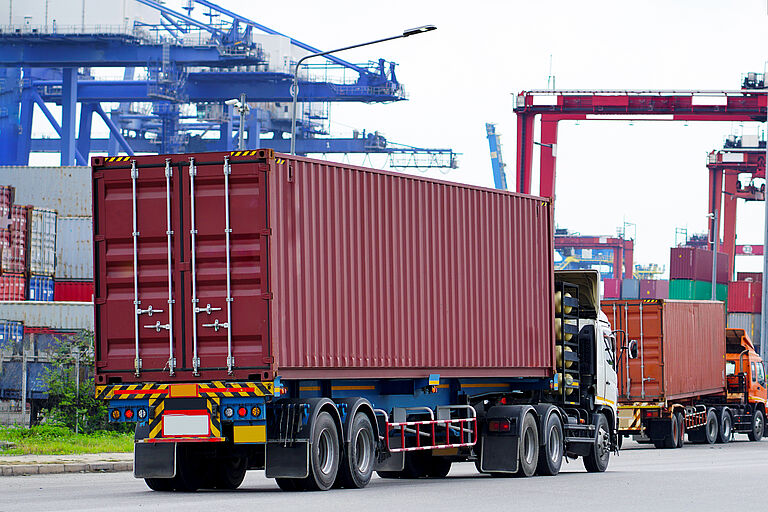
What does that mean, specifically, for a container at the port?

Csaba Barath: Let's look at an import container. Today, we know when the container will arrive at the Port of Hamburg and when it will be delivered. Using additional data from various sources, we want to identify the factors that will affect its transit time.

What volume of data is available for such pattern analyses? 

Csaba Barath: For an average import container, there are more than ten status inquiries until it is physically picked up at the terminal. In addition, data from customs clearance and slot booking is consolidated in our systems. 
Depending on the case, we have data from the past 10 to 20 years at our disposal. In the customs sector, the statutory retention period for digital information is 10 years; our port communication platforms retain the data for up to 20 years. This data consists exclusively of anonymized DAKOSY process data that does not allow any conclusions to be drawn about individual orders or customers.

What specific application is the team currently working on?

Rachel Schröder: One of the most commonly-requested uses of our data lakehouse is self-service offerings and business intelligence (BI). We not only make data available for export, but also prepare it — for example, in dashboards, visualizations, and standardized evaluations. After internal testing, our service will enter the pilot phase in the first quarter of 2027. Scaling and rollout are planned for mid-2027.

Emails, PDFs, and other unstructured documents consume a lot of time in logistics. How can AI help?

Csaba Barath: We want to make day-to-day freight forwarding and customs processes easier. Users should be able to formulate their requests in natural language and receive answers or relevant results. AI assistants can, for example, help create customs declarations and transport orders or automatically trigger certain actions. Our advantage: with our historical logistics data, we can guide customers through the processes more precisely and reliably than providers without this data.

Incorrect AI results can have serious consequences, especially at customs or in business-critical logistics processes. How can we ensure that the answers remain reliable, traceable, and verifiable?

Rachel Schröder: Anyone who feeds unverified data into an AI system and blindly trusts its results risks errors that may not be detected until it’s too late. Especially in critical processes, so-called “hallucinations” can cause damage and result in significant costs. 
AI systems operate based on probability and do not offer 100 percent certainty. That is why human oversight and evaluation remain necessary. AI itself can serve as an additional layer of verification and, for example, issue a warning if an action deviates from previous behavior. The key lies in the interaction between humans and the system, which complement and monitor each other.

When can AI make decisions on its own, and when is a human specialist still required?

Rachel Schröder: That depends heavily on the requirements of the digital application. If there is zero tolerance for errors, a human must still review the work and provide final approval. Where errors can be detected and corrected without serious consequences, processes can be largely automated with appropriate verification mechanisms.

(Photo credits conversation situation: Christoph Niemann, for the other photos Adobe Stock)

Other interesting articles