Testimonial • 01.12.2026
Intelligent preliminary processing for customs
DAKOSY develops Merge2Declare for Swiss Post Cargo
At Swiss Post Cargo, automated customs clearance does not begin with the ZODIAK GE customs software, but rather with the upstream module Merge2Declare. DAKOSY’s new development prepares import customs declarations by structuring, consolidating, and cleaning up the required data, thereby laying the foundation for largely automated customs clearance processes.

About Swiss Post Cargo
Swiss Post Cargo is the freight logistics division of Swiss Post. The company employs over 2,000 people and specializes in warehousing, transportation, and customs processing clearance solutions for business customers in Switzerland and the neighboring economic regions. Swiss Post Cargo connects industry, commerce, and institutions to national and international streams of goods and plays a key role in securing efficient supply chains in its core markets.
www.swisspost-cargo.com
By the time most people start their workday at 8:00 a.m., Swiss Post Cargo has already processed up to 20,000 customs clearances. Over the course of the day, an average of 20,000 to 25,000 additional customs clearances are processed. During peak periods — such as Black Friday, Cyber Week, or the pre-Christmas season — the volume climbs to even higher levels. Roland Iten, Director of Customs Clearance at Swiss Post Cargo explains:
“Without Merge2Declare, it would be impossible to handle these large volumes within such a short time frame. In nearly all cases, the raw data is not provided in the format we need to meet customs requirements.”
The task for Swiss Post Cargo also includes a smart pre-processing step for customs procedures. This gave rise to the idea for the new DAKOSY module, Merge2Declare. With ZODIAK GE, the Hamburg-based software service provider offers a centralized solution for Swiss Post Cargo’s import and export customs operations in Switzerland and Germany, including e-commerce processing.
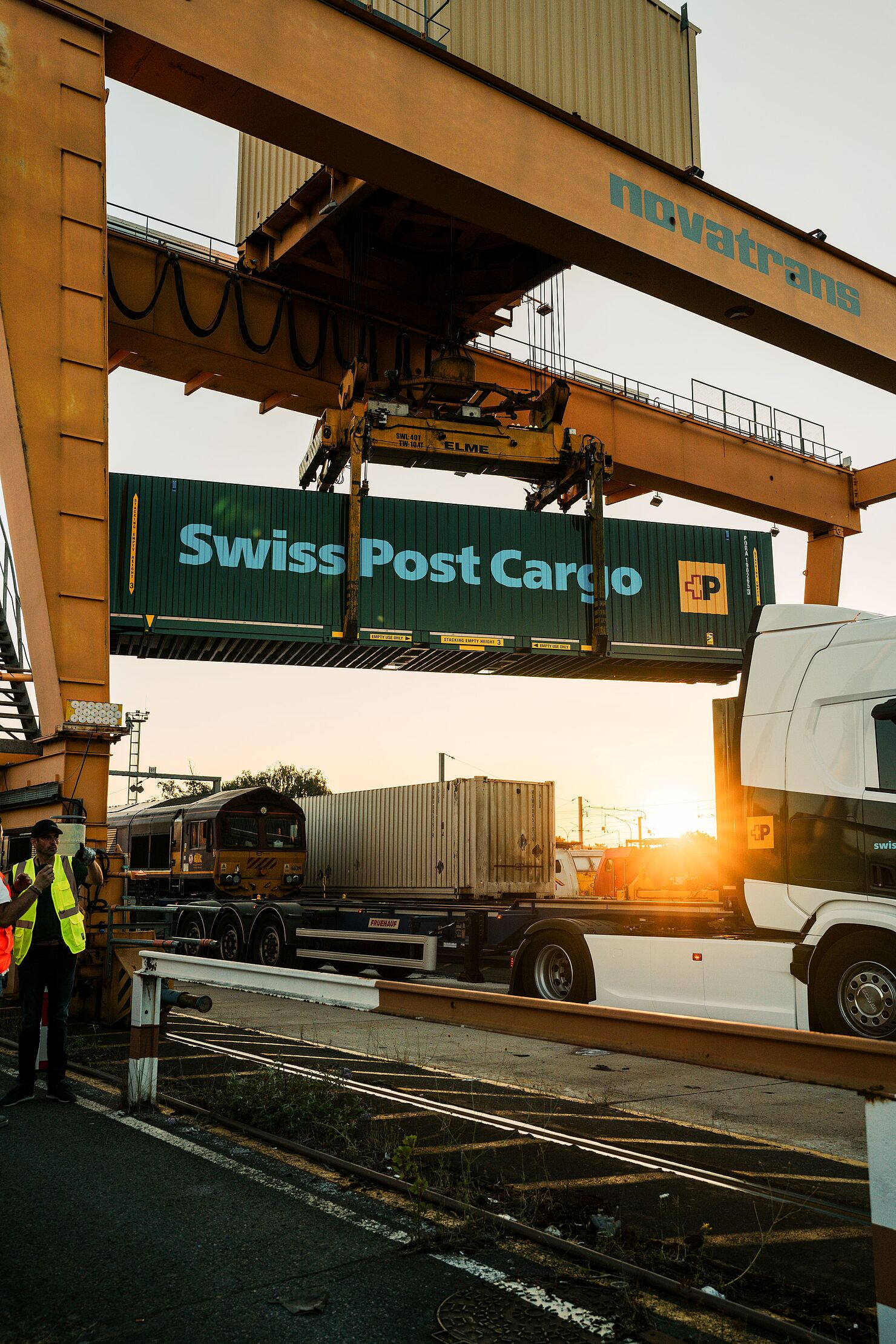
Behind the scenes, DAKOSY makes those large volumes of data manageable. After all, the systems must process these volumes reliably within a short time frame and transmit them to the customs systems in a controlled manner. Particularly during peak periods, the data streams must be managed effectively. “We can use technology to regulate processing so that declarations are transmitted in parallel or in defined batches at set intervals,” reports Linder.
Customs releases allocated to individual packages
After customs clearance, the information flows back from ZODIAK GE into Merge2Declare. The customs authority reports the status of a customs declaration, but not the status of each individual package included in it. For operational logistics, however, it must be clear which packages are permitted to be subsequently processed. “Using the package numbers entered in Merge2Declare, the customs response can be broken down again to the individual physical units,” explains Huber. This allows the customs status to be assigned to the respective shipping units and used for further processing.
Preparation is essential to achieve results
For the module to be fully effective, careful preparation with customers is required. Master data and tariff numbers must be matched and reviewed. Huber shares his experience: “Setup takes about a month, after which the automated processes take effect, which also lead to improved data quality.” Preparation was also important for the roughly 120 declarants at Swiss Post Cargo when the upstream system was integrated. The principle: learning from one another. DAKOSY first trained the so-called “super users,” who then passed on their knowledge internally. Swiss Post Cargo also created their own in-house training videos. According to Huber, the videos were well received because the content can be viewed again at any time.
From customer project to standard module
DAKOSY Sales Manager Linder estimates that the development period for Merge2Declare was about four months. This is paying off for Swiss Post Cargo: large volumes of shipments are prepared for customs clearance with only minimal manual intervention — and at high speed. “Looking ahead, Merge2Declare is planned to be made available to the market as a standardized product,” Linder says.
(Photo credits: Swiss Post Cargo Holding AG)

“Looking ahead, Merge2Declare is planned to be made available to the market as a standardized product.”